
How to Prepare for Colombia: The Honest Checklist
There are dozens of Colombia preparation checklists online. Most of them are the same: get travel insurance, notify your bank, bring sunscreen.
Those things are fine. They’re also the easy part.
This checklist is different because it’s built around what actually determines whether your Colombia trip goes smoothly — not just whether you survive it. The practical logistics are here, but so are the things that don’t make the standard lists: cultural prep, language prep, and the mental model shifts that separate travelers who arrive ready from those who spend their first three days catching up.
Start Here: The Mindset Before the Checklist
Colombia is not a difficult destination. It is a nuanced one.
The mistake most travelers make is treating preparation as logistics — documents, apps, vaccinations — and showing up culturally and linguistically empty. That approach works fine in destinations built around tourism infrastructure. Colombia rewards people who did more than book a flight.
Here’s the frame: preparation in Colombia is a competitive advantage. Travelers who arrive having done real prep get treated differently, pay less, access more, and have a fundamentally different experience than those who didn’t.
With that said — the checklist.
Documents and Legal Basics
- Passport valid for at least 6 months beyond your travel dates. Colombia enforces this.
- No visa required for most nationalities for stays up to 90 days (US, UK, EU, Canada, Australia). Check your specific nationality — requirements shift.
- Entry card (Tarjeta de Migración): filled out on arrival or online before departure. Some airlines distribute these on the flight. Have it completed before you land.
- Copies of your passport: one physical copy in a separate bag from your passport, one digital copy stored in your email or cloud.
- Travel insurance documentation: printed or saved offline. Know your policy number and the emergency contact number.
Money: What the Standard Advice Gets Wrong
Most guides tell you to notify your bank. That’s correct but incomplete.
Here’s what you actually need to understand about money in Colombia:
- Colombian ATMs (cajeros) commonly trigger fraud alerts on foreign cards — especially US cards. Notify your bank before departure and be specific about the dates and country.
- Airport exchange rates are poor. Don’t exchange more than you need to get through the first day. Exchange in the city at a reputable casa de cambio or withdraw from ATMs in commercial areas (not streets).
- ATM withdrawal limits in Colombia are often low — around 300,000-400,000 COP per transaction (roughly $75-100 USD). Plan accordingly, especially for trips to smaller cities.
- Know the current exchange rate before you land. At time of writing, 1 USD = approximately 4,000+ COP, but this fluctuates. Carry a rough mental conversion so you’re not guessing at prices.
- Cash matters more than most travelers expect. Many local restaurants, taxis, and smaller businesses are cash-only. Always carry some COP.
- Uber exists in Colombia but operates in a legal grey zone in some cities. InDriver is widely used and often cheaper. Download both before arrival.
Health and Vaccinations
- Yellow fever vaccination: required if you’re traveling to certain regions (Amazon, some coastal areas). Not required for Medellín or Bogotá, but recommended if your itinerary includes jungle or rural areas. Carry your vaccination card — some border crossings require proof.
- Routine vaccinations: hepatitis A, typhoid, and tetanus are recommended. Consult a travel health clinic at least 4-6 weeks before departure.
- Altitude: Bogotá sits at 2,600 meters (8,500 feet). Expect adjustment time — headaches and fatigue are common in the first 24-48 hours. Medellín is much lower at around 1,500 meters and rarely causes problems.
- Mosquito protection: relevant for coastal and lowland areas. Standard DEET repellent, long sleeves in the evenings.
- Water: drink bottled or filtered water. Ice in tourist-facing restaurants is generally safe; street ice is not.
- Travel insurance with emergency medical coverage is not optional. Healthcare in major Colombian cities is good — but you need coverage for evacuation if something serious happens outside a major city.
Connectivity and Apps
Getting connected on arrival is straightforward and should be done at the airport before anything else.
- SIM card: Claro and Tigo are the two reliable networks. Both have airport counters. A local SIM with data costs very little and solves every connectivity problem immediately.
- WhatsApp: this is how Colombia communicates. Your accommodation, local contacts, tour operators, and restaurants all use it. Have it installed and linked to a number before or immediately after arrival.
- Google Maps offline: download your city’s map before you land. Works without data connection once downloaded.
- InDriver and Uber: both installed and ready before arrival.
- Google Translate with Spanish downloaded offline: for moments when conversation breaks down completely.
- XE Currency: real-time exchange rate reference.
Cultural Preparation: The Part Most Lists Skip
This is where most Colombia preparation guides end. It’s also where the meaningful preparation begins.
Greetings
The cheek-kiss greeting (un beso) is standard in Colombia between people who know each other and increasingly in first meetings in social contexts. Men typically shake hands with other men initially; women and mixed-gender introductions often involve the cheek greeting. Watch what people around you are doing and mirror it. Getting this wrong is not a disaster — but getting it right is noticed.
Usted vs. Tú
Colombia, particularly the interior (Medellín, Bogotá, Coffee Region), uses ‘usted’ as the default — even in casual conversation, even between friends. Default to ‘usted’ until context tells you otherwise. It signals respect and cultural awareness.
Time and Plans
Colombian time is famously flexible. ‘A las 3’ might mean 3:30. Social plans shift. This is not rudeness — it’s a different relationship with time. Adapt to it rather than fighting it. Build buffer into plans and don’t interpret lateness as disrespect.
Bargaining and Prices
Bargaining is appropriate in markets and informal settings. It is not appropriate in restaurants, shops with listed prices, or formal businesses. The key is confident, friendly negotiation — not aggression. A smile and ‘está un poco caro’ (it’s a bit expensive) is usually more effective than a hard push.
Safety Awareness
Colombia’s safety situation is dramatically better than its reputation suggests — particularly in Medellín, Bogotá, Cartagena, and the Coffee Region. The risks that remain are primarily petty crime (phone theft, pickpocketing) concentrated in specific areas. The precautions are common sense:
- Don’t display your phone in obvious ways on the street, particularly in El Centro or crowded public spaces.
- Use Uber/InDriver rather than hailing taxis off the street in unfamiliar areas.
- Don’t accept drinks from strangers in nightlife environments. Scopolamine (burundanga) spiking is a real and documented risk.
- Trust your environment read. Tourist zones are generally safe. Areas that feel wrong usually are.
Language Preparation: The Non-Negotiable Item
You do not need to be fluent in Spanish to have a great Colombia trip. But you need more than zero Spanish, and you need the right kind of Spanish.
The standard tourist phrases — ‘una cerveza por favor,’ ‘dónde está el baño’ — get you through basic transactions. They don’t get you through conversations. And Colombia rewards conversation.
At minimum, before you land:
- Learn the core Paisa greetings: ¿qué más?, parce, bacano, listo.
- Practice listening to Colombian Spanish at real speed — not just reading phrases.
- Know how to slow a conversation down: ‘más despacio, por favor’ and ‘¿me puede repetir?’
- Learn how to express that you’re learning: ‘estoy aprendiendo español’ opens more doors than pretending you’re fluent.

Packing: The Colombia-Specific Items
Standard packing lists apply. A few Colombia-specific additions:
- Power adapter: Colombia uses Type A and B plugs (same as US/Canada). European travelers need adapters.
- Light rain layer: Medellín has afternoon rain year-round. Bogotá is frequently cold and rainy. A packable rain layer is more useful than an umbrella.
- Altitude layers for Bogotá: it gets genuinely cold in the evenings at 2,600m. Most travelers underpack for this.
- Minimal jewelry and visible luxury items: common sense in any urban environment, more relevant in Colombia.
- A small day bag rather than a large backpack for city movement: less conspicuous, more practical.
The Final Check: What Separates Ready from Not Ready
Run through this before you land:
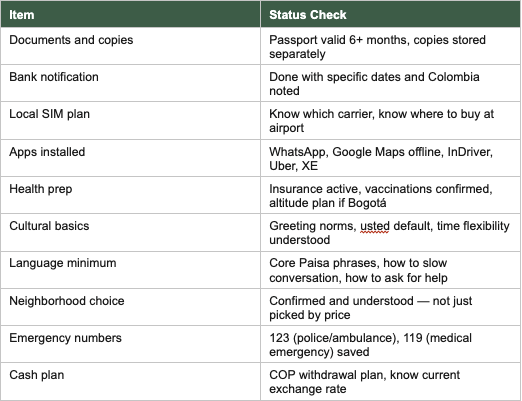
If you can check all of those boxes, you’re ahead of 90% of travelers who land in Colombia.
If there are gaps — particularly on language and neighborhood choice — those are the ones worth closing before departure.