Paisa Slang Guide: What Locals Actually Say and What It Means

If you’ve studied Spanish — formally or informally — you have a foundation. But that foundation was built on a version of Spanish that is not spoken in Medellín.
Paisa Spanish is its own thing. The accent (a distinctive singsong lilt that rises and falls in ways other Spanish speakers find charming and occasionally impenetrable), the slang, the social codes around language — all of it is specific to Antioquia, the region that Medellín anchors.
The good news: Paisas are extraordinarily warm toward people who make a genuine effort. Getting even a few of these right — delivered naturally, not recited — changes how you’re received.
This guide covers the essential vocabulary, how it’s actually used, and the context you need to not sound like you memorized a list.

Why Paisa Slang Is Different From Standard Colombian Spanish
Colombian Spanish — particularly from Bogotá — is often cited as among the clearest and most neutral in Latin America. Paisa Spanish diverges from that in several important ways:
- The accent: Paisas speak with a rising-falling melody that’s immediately recognizable. Vowels are elongated. The rhythm is different from standard Spanish in ways that even fluent speakers need time to adjust to.
- The pronoun: Paisas use ‘usted’ where most Latin Americans use ‘tú’ — including with close friends, family members, and in casual settings. This is a cultural marker, not formality.
- The vocabulary: Antioquia has developed its own lexicon over generations, drawing from indigenous languages, coastal influences, and its own linguistic creativity. Many words used daily in Medellín don’t exist in other Spanish-speaking countries.
The result is a dialect that sounds like Spanish and is Spanish — but requires specific calibration to navigate fluently.
The Essential Paisa Vocabulary
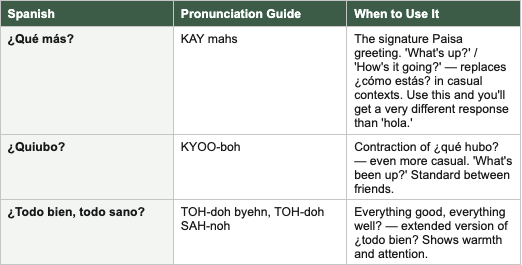
Greetings and openers
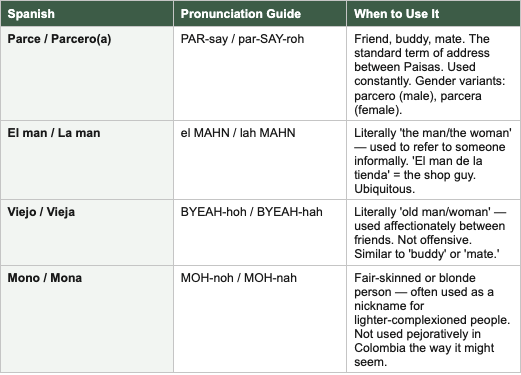
Terms of address — how Paisas talk to each other
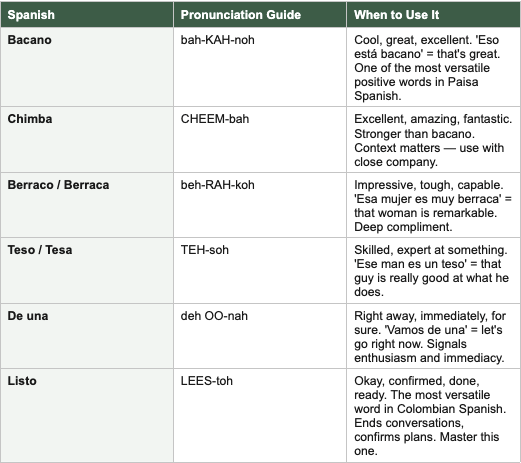
The core positive vocabulary
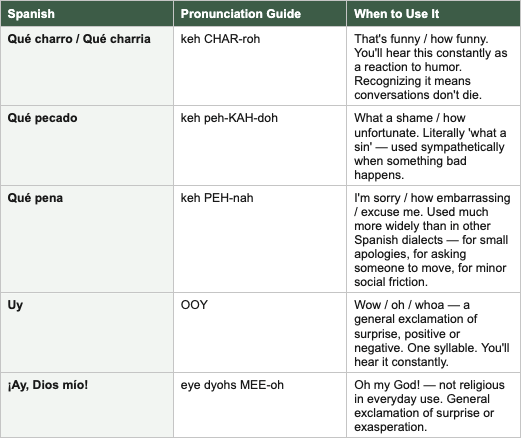
Reactions and responses — what to say when things happen
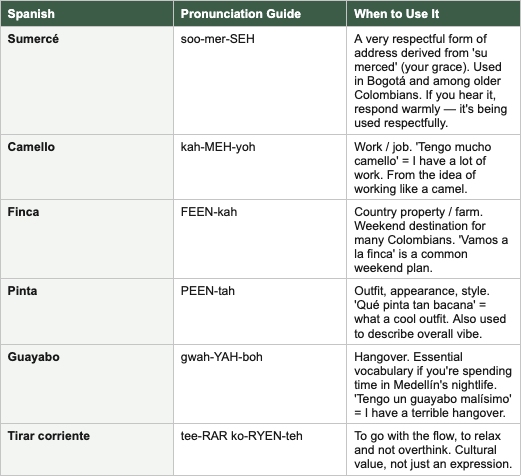
Useful situational vocabulary
The Social Register: When to Use What
Knowing the words is one thing. Knowing when and how to deploy them is what separates someone who sounds naturally connected from someone who sounds like they memorized a list.
A few principles:
- ‘¿Qué más?’ is your universal opener. Use it confidently, with any Paisa, in any casual context. It always lands well.
- ‘Parce’ and ‘parcero’ are casual — use them with people your age in informal settings, not with older Colombians or in formal contexts.
- ‘Listo’ is universal and always appropriate. When in doubt, ‘listo’ closes or confirms almost any exchange.
- ‘Qué pena’ is used more widely than you’d expect — it’s not just for serious apologies. Use it for asking someone to excuse you, for small inconveniences, for any moment that calls for light social courtesy.
- The compliments (bacano, chimba, berraco) are powerful but read the room. Use them genuinely, not to perform familiarity you haven’t earned yet.

The Paisa Accent: What to Listen For
The vocabulary is learnable in a few hours. The accent takes longer.
The key features of Paisa speech:
- The singsong cadence: phrases rise in the middle and fall at the end in a pattern that’s distinct from standard Spanish. Your ear calibrates to it over a few days — don’t panic if conversations feel fast and melodically strange at first.
- Extended vowels: Paisas often extend vowel sounds for warmth and emphasis. ‘Buenas’ becomes ‘bueeeenas.’ ‘Listo’ becomes ‘listooo.’ It signals warmth, not slowness.
- Speed: once a Paisa registers that you speak Spanish, they will speak to you at full speed. This is a compliment — they’re treating you as a capable speaker. Have ‘¿me puede hablar más despacio?’ ready.
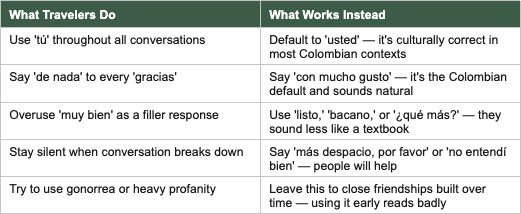
What Not to Say: The Common Errors
A few things travelers get wrong:
Going Further: From Vocabulary to Real Conversation
A list gets you started. Real conversation requires something more.
The gap most travelers hit isn’t vocabulary — it’s the listening side. They use a Paisa opener confidently and then freeze when the response comes back at full speed, in Paisa rhythm, with slang layered in.
Closing that gap requires practicing with real audio — not just reading phrases, but hearing Colombian Spanish spoken naturally and building the response reflexes to keep a conversation moving.
That’s what the Lingo Society course is built around: real Colombian Spanish audio, situation-based rather than classroom-based, designed to prepare you for actual conversation rather than tourist transactions.